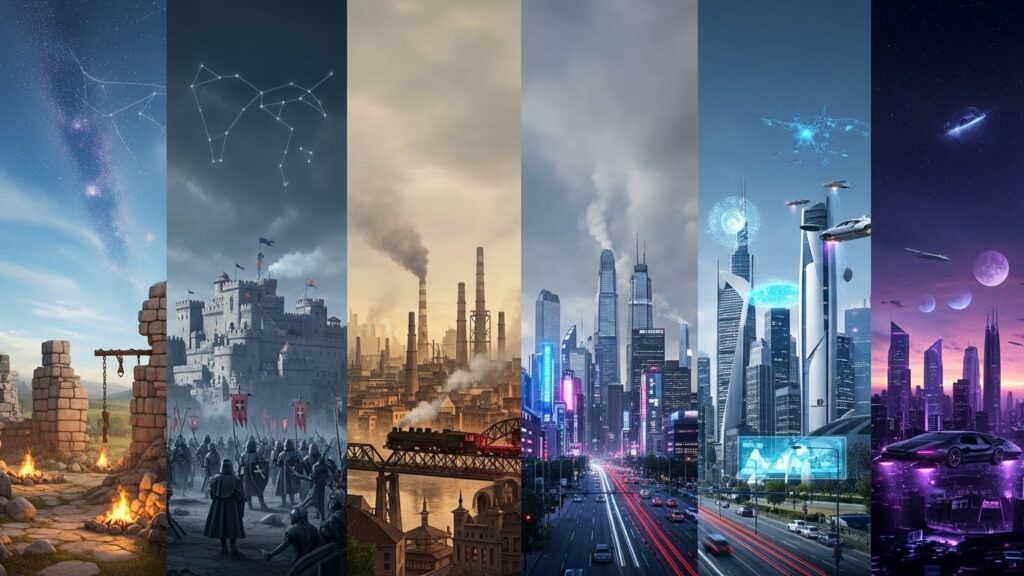
Pentachronism is not a term most people encounter in everyday conversation, yet it carries intriguing potential for philosophy, art, anthropology, and even modern technology. At its core, pentachronism can be interpreted as a framework involving five distinct layers or perceptions of time existing simultaneously. Some use the word to describe a worldview where multiple eras overlap; others see it as a creative lens for examining historical cycles or temporal awareness. This concept invites us to question how past, present, and future interact. It also challenges us to think about the ways humans perceive change across generations, cultures, and innovations. Introducing pentachronism early in this discussion is essential because the term itself opens a door into deeper questions about consciousness, society, and the timeline of human experience.
In philosophy and cultural studies, pentachronism offers a unique way to interpret historical development. It suggests that no single era exists in isolation; instead, it remains influenced by what came before and will shape what emerges next. This kind of temporal layering connects ancient traditions to modern lifestyles and future possibilities. When we observe pentachronism in storytelling or academic discourse, we see a thematic pattern: time is not linear, but cyclical and interconnected. This perspective can transform how we understand progress, decay, and legacy. In a world that evolves rapidly—with digital technology, shifting values, and globalization—pentachronism becomes a powerful tool for grounding ourselves within the continuum of human evolution.
By exploring pentachronism in multiple contexts throughout this article, we will uncover how it appears in mythologies, architecture, social identity, and even psychology. With careful analysis, real examples, and structured guidance, the concept becomes not only understandable but deeply relevant to modern thought. Pentachronism encourages curiosity, sparks innovation, and helps us reflect on where we have been—and where we may be headed. The following sections will serve as a roadmap for comprehensively understanding this multifaceted term and its potential impact on how we read history, interpret the present, and imagine the future.
Origins and Interpretation of Pentachronism
Pentachronism likely stems from Greek linguistic roots: penta meaning five and chronos meaning time. This etymology suggests a framework involving five layers or cycles, each representing a distinct temporal dimension. In some speculative studies of mythology and literature, pentachronism describes civilizations that maintain traditions from five different eras simultaneously. The concept allows scholars to map cultural persistence—rituals, language structures, social values—across long stretches of time. When pentachronism is applied to historical inquiry, it becomes a lens through which time appears stratified rather than continuous. Understanding this origin deepens appreciation for its modern relevance. It helps us see how ancient ideas may live on through political systems, design principles, or ethical frameworks, even if the surrounding world changes dramatically.
The interpretation of pentachronism varies depending on academic discipline. In anthropology, it may illustrate how indigenous practices endure alongside digital globalization. In art history, pentachronism can explain why classical motifs reappear in contemporary media. The ability for five temporal planes to overlap challenges assumptions about linear progress. Instead, pentachronism suggests recurrence, recursion, and resonance. Each time frame influences the others, creating a dialogue across centuries. This interpretation can inspire new questions: How many eras shape our identity today? Which historical cycles are we unconsciously repeating? When viewed from this standpoint, pentachronism becomes more than a definition—it becomes a tool for critical inquiry, encouraging deeper philosophical and cultural awareness.
Read More: Calidancingfool
Pentachronism in Cultural Traditions
Cultural pentachronism can be observed in societies where ancient customs survive in modern settings. The ceremonial attire of certain nations, for example, may reflect five chronological influences: prehistoric symbols, medieval craftsmanship, colonial modifications, industrial fabric accessibility, and contemporary reinterpretation. Here, pentachronism is a living reality, blending aesthetic and ideological time layers. A community celebrating a thousand-year-old solstice ritual while livestreaming it globally demonstrates this fusion vividly. Pentachronism is not hypothetical; it is tangible, recorded in food, music, religion, and family lineage. When we observe a dish that combines indigenous grains, centuries-old spice routes, industrial-scale production, and modern plating trends, we witness pentachronism embodied in cuisine. It tells us that history never truly disappears—it evolves and integrates.
Comparing societies worldwide reveals degrees of pentachronism. Japan, for example, reveres ancient Shinto rites yet leads cutting-edge robotic innovation. Italy’s Renaissance artistry flows through contemporary fashion. Even the United States shows pentachronistic patterns where frontier folklore, industrial capitalism, digital enterprise, and future-oriented space exploration exist within the same cultural landscape. These examples illustrate cultural layering rather than replacement. Pentachronism provides vocabulary for describing this coexistence. It clarifies why people may feel nostalgia, modern ambition, and ancestral duty at the same time. Recognizing pentachronism in tradition helps us appreciate cultural complexity and continuity. It invites us to trace the roots of behaviors, recognize the weight of history, and celebrate the richness of temporal overlap.
Philosophical Dimensions of Pentachronism
Philosophically, pentachronism encourages reflection on time as a multidimensional force. It breaks apart the simplistic notion that history moves forward in a single file line. Many thinkers suggest that pentachronism reflects the layered nature of consciousness itself. A person can mourn the past, function in the present, plan the future, daydream in possibility, and remember inherited stories—all at once. These five mental timelines align with the essence of pentachronism. The idea becomes relevant not only to grand historical narratives but to the everyday human psyche. The mind is a pentachronic space where memory, perception, expectation, imagination, and collective history interact. Such reflection enriches emotional intelligence and awareness of personal growth.
A philosophical model of pentachronism can also illuminate ethical decision-making. If we understand ourselves as participants in multiple timelines, we may act with more responsibility toward those yet to come. Pentachronism reminds us that future generations inherit our choices, just as we inherited those of our ancestors. This principle encourages sustainable thinking, compassionate policy agendas, and culturally respectful innovation. In moral discourse, pentachronism strengthens accountability. It tells us that time is shared—not owned—and that our actions ripple outward across epochs. Recognizing pentachronism may help reconcile generational conflict, guide environmental stewardship, and foster long-term planning beyond short-term convenience.
Pentachronism as a Lens for Historical Study
Historians can use pentachronism to chart the cyclical behavior of empires, technologies, and social movements. For example, one could identify five major phases in the rise and fall of a nation, then compare them to patterns seen elsewhere. Pentachronism transforms history from a list of dates into a web of recurring dynamics. It allows researchers to track how ideas migrate—or reemerge. This model can help compare Rome with the British Empire, or the Industrial Revolution with the Digital Age. Pentachronism gives historians vocabulary to discuss continuity across centuries. It illuminates the hidden threads that bind civilizations together. With pentachronism, history becomes interactive and alive, not static.
Researchers also use pentachronism to understand how technology evolves—not just in leaps, but in cycles. Consider transportation: walking, animal domestication, the wheel, engines, and autonomous systems represent five chronological nodes. Each stage remains present today, coexisting rather than replacing the other. This is pentachronism in technological history. In medicine, ancient herbal remedies persist alongside advanced gene therapy. In architecture, stone masonry supports skyscrapers equipped with smart sensors. Historical pentachronism reveals continuity where many assume replacement. It reminds us that progress is additive rather than destructive; layers build on layers. This perspective prevents oversimplification and encourages more comprehensive historical thinking.
Pentachronism in Modern Media and Literature
Writers often employ pentachronism to structure narratives across multiple timelines. Novels like Cloud Atlas or films like Interstellar play with layered temporal storytelling. Characters may exist in five distinct eras, each influencing the next. Pentachronism becomes a narrative architecture that strengthens emotional impact. Readers experience time as fluid and intertwined. This approach enhances thematic depth, allowing authors to explore destiny, causality, and identity. The technique also mirrors how real people perceive life—through layered memory and anticipation. When fiction integrates pentachronism elegantly, audiences walk away questioning their own relationship with time.
Modern media reinforces pentachronism visually. Video game universes often merge medieval swords, futuristic space travel, industrial grit, and ancient myth. Graphic novels jump between ancestral flashbacks and post-modern cities. These creative choices reflect an intuitive understanding of pentachronism. Contemporary audiences expect multi-era resonance because they live in a pentachronic world: smartphones beside vinyl records, electric cars beside horse-drawn tourism, traditional calligraphy beside digital typography. Entertainment simply mirrors the temporal layering we already inhabit. Pentachronism enriches storytelling and expands creative potential. It breaks boundaries between epochs and celebrates time as dynamic.
Psychological and Social Functions of Pentachronism
Psychologists may use pentachronism to describe how individuals internalize generational memory. A person may carry a grandparent’s trauma, a parent’s values, their own lived experience, and projections of their children’s futures. These five timelines coexist emotionally. Pentachronism illustrates how identity is shaped not just by the present moment, but by the accumulated resonance of time. It explains why people often feel older than they are or stretched between eras. The human brain holds layers of memory like geological strata. Pentachronism provides a descriptive and nuanced way of examining personal continuity.
Socially, pentachronism helps explain shifting conflict between generations. Youth may embrace rapid innovation, while elders cling to traditions rooted in earlier decades. Yet both groups occupy the same temporal plane. Pentachronism suggests that society functions as a layered coexistence of time perspectives. Instead of resisting this diversity, communities can harness it. Elders preserve wisdom; youth envision future possibilities. Pentachronism reframes generational tension into collaborative potential. Recognizing this layered temporality fosters empathy, collective purpose, and social resilience.
Conclusion
Pentachronism is more than an obscure term—it is a powerful lens for understanding the world. By viewing time as layered rather than linear, we recognize how tradition, reality, and imagination coexist. Pentachronism encourages us to notice history in our habits, future potential in our innovations, and cultural memory in everyday life. It invites curiosity and reflection. When we recognize temporal layering in ourselves and society, we gain insight into continuity, responsibility, and human growth.
Whether applied in philosophy, storytelling, cultural analysis, technology studies, or personal introspection, pentachronism opens pathways to deeper understanding. It gives language to a phenomenon we intuitively sense: time is not singular but braided. As you continue exploring this concept, consider how five eras may be influencing you right now—the past you carry, the present you inhabit, the future you plan, the ancestral echoes behind you, and the possibilities ahead. Pentachronism lives within all of us, shaping perception and guiding evolution.